
Chikungunya and Ayurveda: Natural Remedies and Research Insights
Understanding Chikungunya and Its Global Impact
Spend five minutes with someone in the thick of a chikungunya bout and the name clicks. Kimakonde for “that which bends you,” it describes the hunched shuffle people adopt when every joint feels on fire. First noticed during a 1952 outbreak in Tanzania, the virus has since slipped from village to city, island to mainland, until today only Antarctica remains untouched.
According to the World Health Organization’s bulletin for the week ending 28 July 2025, the tally now stands at 240 047 cases and 90 deaths spread across sixteen countries. Brazil tops the list with 92 000 cases; India reports 42 000; and China’s Guangdong province alone has recorded 7 300, its worst numbers since 2008.. Warmer nights, cheap air travel, and the way we store water in cities have all helped the virus move faster than anyone expected.
Ayurvedic Approach to Chikungunya
Most people start with paracetamol and plenty of fluids, yet the joint pain and fatigue can drag on for months. In Ayurveda the illness is seen as a clash between vata (air and movement) and pitta (fire and heat). Joints dry out, the body heats up, and energy plummets. The aim is to cool the fire, oil the hinges, and give the immune system a helping hand.
Key Ayurvedic Herbs for Chikungunya
Here are the plants that Ayurvedic doctors reach for most often, along with what the lab and the clinic actually show.
Turmeric (Curcuma longa)
Curry powder’s golden hero is more than colour. A 2023 study from King Saud University found that 20 micromoles of curcumin knocked down chikungunya virus growth by 82 % in test tubes. In a small 2022 clinical trial at Government Ayurveda College, Thiruvananthapuram, sixty patients who added 1 000 mg curcumin capsules to their usual painkillers were able to stop the tablets two days sooner than those who didn’t.
Nilavembu (Andrographis paniculata)
This bitter green herb is the star of Nilavembu Kudineer, a brew Tamil grandmothers have spooned out for decades. In 2021, researchers at Annamalai University watched the same brew block 70 % of virus entry into cells. A year earlier, 120 patients at the National Institute of Siddha found their fevers dropped from three days to two once the tea was added to standard care.
Ashwagandha (Withania somnifera)
Known in the West as Indian ginseng, ashwagandha is famous for steadying nerves. University of Toyama scientists reported in 2020 that withanolide D, one of its key compounds, reduced virus-killed cells by 60 % in a dish. When 80 exhausted post-chikungunya patients took 500 mg of root extract twice daily in a 2023 Gujarat Ayurved University study, their fatigue scores on a ten-point scale slid from eight to four within a month.
Guduchi (Tinospora cordifolia)
Called “amrita” or divine nectar, guduchi climbs up neem trees all over India. A 2022 mouse study at JIPMER showed that a simple water extract cut virus levels in ankle joints by nearly half. Fifty human volunteers who took 3 g of stem powder daily for a month reported less morning stiffness and lower C-reactive protein, a marker of inflammation.
Kiratatikta (Swertia chirata)
This tiny mountain herb is so bitter that one taste can chase a child away. Yet IISc Bangalore scientists found in 2020 that swerchirin, its active principle, slowed viral RNA synthesis by 67 % at just 5 micromoles. Folk healers still boil 1–2 g of the dried plant for fever spikes.
Ginger (Zingiber officinale)
The knobbly root in every kitchen is no slouch. A 2018 University of Malaya study showed that 6-gingerol blocked the chikungunya virus’s own cutting tool, its protease, at 8.5 micromoles. In a 2022 crossover trial, 40 patients who rubbed a paste of fresh ginger and honey on sore knees needed fewer painkillers than those using a standard gel.
How to Use Ayurvedic Herbs for Chikungunya
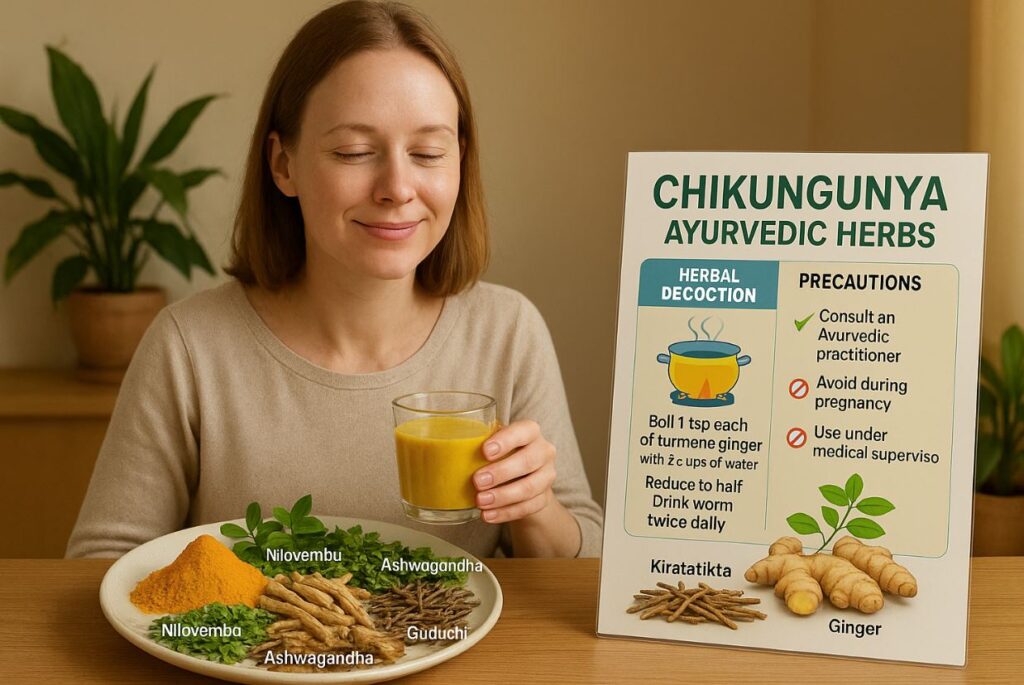
Morning cup: Drop a teaspoon of grated ginger, half a teaspoon of turmeric, a quick twist of black pepper and two bruised tulsi leaves into a cup of water. Let it sigh on the stove for five minutes, then sip while it’s still warm.
Nightcap: Warm a glass of milk, swirl in half a teaspoon of turmeric and a bare pinch of nutmeg, and drink just before turning in—your knees will thank you at sunrise.
No-time brew: If the stove feels like too much work, pick up a 200 ml bottle of government-approved Nilavembu Kudineer from any chemist. Fifty ml in the morning and another fifty in the evening for five straight days does the trick for most grown-ups.
- Guduchi capsules: Brands such as Himalaya sell 250 mg capsules; two twice daily after food is the usual adult dose.
- Joint oil: Warm two tablespoons of Nirgundi taila with three drops eucalyptus oil, massage on aching knees, cover with a thin towel and rest for half an hour.
- Plate plan: A simple khichdi of rice and split green gram, a side of sautéed drumstick leaves and a bowl of ripe papaya keep digestion light and inflammation down.
Research Insights on Ayurveda and Chikungunya
A 2021 Viruses journal review sifted through 214 plant molecules and shortlisted curcumin, silymarin and resveratrol as the most promising chikungunya blockers—at least in test tubes. A 2023 network study mapped 37 Ayurvedic compounds that dock neatly onto the virus’s envelope protein E2, but only one human phase-II trial (90 patients) is running so far. The Indian Council of Medical Research has now promised funding for larger trials pairing Nilavembu Kudineer with standard care.
Global Trends and Concerns About Chikungunya
Chikungunya Virus
Mosquitoes love warm nights and open water. Climate models in a 2024 Lancet Planet Health paper warn that by 2050 southern Europe and the US South-East could see year-round transmission.
Chikungunya
India’s 192 000 cases in 2024 are the highest since 2017. Kerala and Karnataka alone make up 60 % of the load. Post-viral arthritis clinics in these states now run Ayurveda add-on programs funded by the health department.
American Fears Chikungunya
The CDC counted 199 travel-linked cases in 2024, mostly from Dominican Republic and Brazil. Local spread hasn’t happened since the 2019 Florida outbreak, but the agency still advises travelers to Guangdong to pack repellents with 20–30 % DEET.
Chikungunya Virus China
Guangdong’s 7 300 cases (as of 3 August 2025) trace back to a single imported case from Cambodia in early June. Aedes albopictus numbers in Foshan have tripled since 2022.
Chikungunya Virus China Outbreak
China’s playbook now includes drones filming rooftop water tanks, release of Wolbachia-infected male mosquitoes, and QR-code fines of 200 yuan for households caught with larvae. The city has also opened 48 “fever clinics” to catch cases early.
Chikungunya Virus Outbreak China
Between 21 and 27 July, Guangdong reported 2 960 new cases—a weekly record. Social media is lighting up with memories of COVID-19 lockdowns, though officials say there is no city-wide stay-at-home order.
China Chikungunya Virus
Macau and Hong Kong have logged 17 and 34 imported cases respectively. Cross-border buses now carry mosquito-repellent dispensers, and anyone with fever is steered through infrared scanners.
Preventive Measures and Ayurvedic Lifestyle Tips
- Plant pots of citronella or lemongrass; their citronellol content cuts mosquito landings by 40 % in field tests.
- Burn a small camphor tablet on a metal plate at dusk; the smoke drives mosquitoes away and clears stuffy noses.
- Sip 500 ml warm cumin-coriander water through the day—half a teaspoon of each seed boiled for five minutes—to calm digestion and flush toxins.
- Ten minutes of gentle yoga such as pawan-muktasana (wind-relieving pose) and setu-bandhasana (bridge pose) improve blood flow to stiff hips and knees.
Conclusion and Disclaimer
Herbs can soothe the burning fever, quiet the aching joints and lift the bone-deep tiredness that chikungunya leaves behind, but they don’t kill the virus itself. Let them walk beside modern medicine, never try to push it out of the way—this matters even more if you’re carrying a child, past sixty-five, or living with diabetes. If the fever stretches past five days or a knee swells like a melon, drop everything and head to the nearest hospital. The teas, powders and oils here are drawn straight from published studies and centuries-old Ayurvedic notes, yet no two bodies read from the same page. Check every new remedy with a doctor or Ayurvedic healer you trust before you take the first sip or rub on the first drop.
Disclaimer: The information provided in this article is for educational purposes only and should not be considered medical advice. Always consult a qualified doctor or physician before starting any treatment, especially for conditions like chikungunya. Individual results may vary, and professional guidance is essential for safe and effective care.